



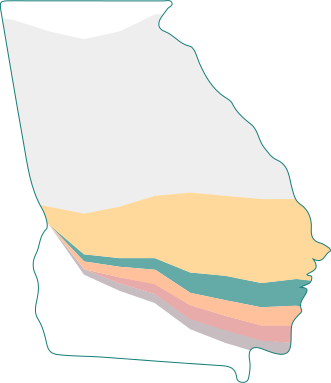


Head over to the Carbon Reduction Visualizer to explore data on Georgia’s greenhouse gas emissions. You can see how emissions fall if we scale solutions to ambitious, but achievable, levels.
Electricity
Here’s the deal
Accelerating Georgia’s progress to renewables means increasing solar and putting waste heat to work in co-generation plants, capturing methane from landfills and turning it into power, and shifting our electricity usage to off-peak.
9
Mt

Cogeneration
Coge...
Cogeneration plants capture heat from industrial processes to warm buildings, manufacture products, or create electricity. Georgia’s textile, pulp and paper, food processing, lumber and other wood industries can help us reduce emissions by 1 million metric tons if 16 factories in the state capture waste energy to generate at least 25 MW of electricity each.

Demand
Response
Dema...
If more Georgians reduce electricity usage during “peak load” periods, we can reduce emissions significantly. If 187,000 households shift 10% of their peak to off-peak demand, we’ll eliminate 1 million metric tons of carbon emissions.

Rooftop Solar
Roof...
Solar panels combined with battery storage means buildings do not have to rely on gas- and coal-fired power that comes over the wires. By 2030, we could reduce emissions by 1 million metric tons if 295,000 new 5 kW solar roofs are installed.

Large-Scale
Solar
Larg...
Sometimes called solar farms, these large-scale installations feed electricity into the grid to power homes, schools, business and industry. By 2030, we could reduce emissions by 1 million metric tons if 10 additional 100 MW utility-scale solar installations and 36 additional 5 MW community solar systems come online.

Landfill
Methane
Land...
Landfill gas (methane) can be captured and put to use, preventing pollution and generating electricity and natural gas. We could reduce emissions by 1 million metric tons if 4 additional landfill facilities are retrofitted to house 5 MW gas-to-energy systems.
Cogeneration
Cogeneration plants capture heat from industrial processes to warm buildings, manufacture products, or create electricity. Georgia’s textile, pulp and paper, food processing, lumber and other wood industries can help us reduce emissions by 1 million metric tons if 16 factories in the state capture waste energy to generate at least 25 MW of electricity each.
Learn More
Demand Response
If more Georgians reduce electricity usage during “peak load” periods, we can reduce emissions significantly. If 187,000 households shift 10% of their peak to off-peak demand, we’ll eliminate 1 million metric tons of carbon emissions.
Learn More
Rooftop solar
Solar panels combined with battery storage means buildings do not have to rely on gas- and coal-fired power that comes over the wires. By 2030, we could reduce emissions by 1 million metric tons if 295,000 new 5 kW solar roofs are installed.
Learn More
Large-Scale Solar
Sometimes called solar farms, these large-scale installations feed electricity into the grid to power homes, schools, business and industry. By 2030, we could reduce emissions by 1 million metric tons if 10 additional 100 MW utility-scale solar installations and 36 additional 5 MW community solar systems come online.
Learn More
Landfill Methane
Landfill gas (methane) can be captured and put to use, preventing pollution and generating electricity and natural gas. We could reduce emissions by 1 million metric tons if 4 additional landfill facilities are retrofitted to house 5 MW gas-to-energy systems.
Learn more
Here’s where we are
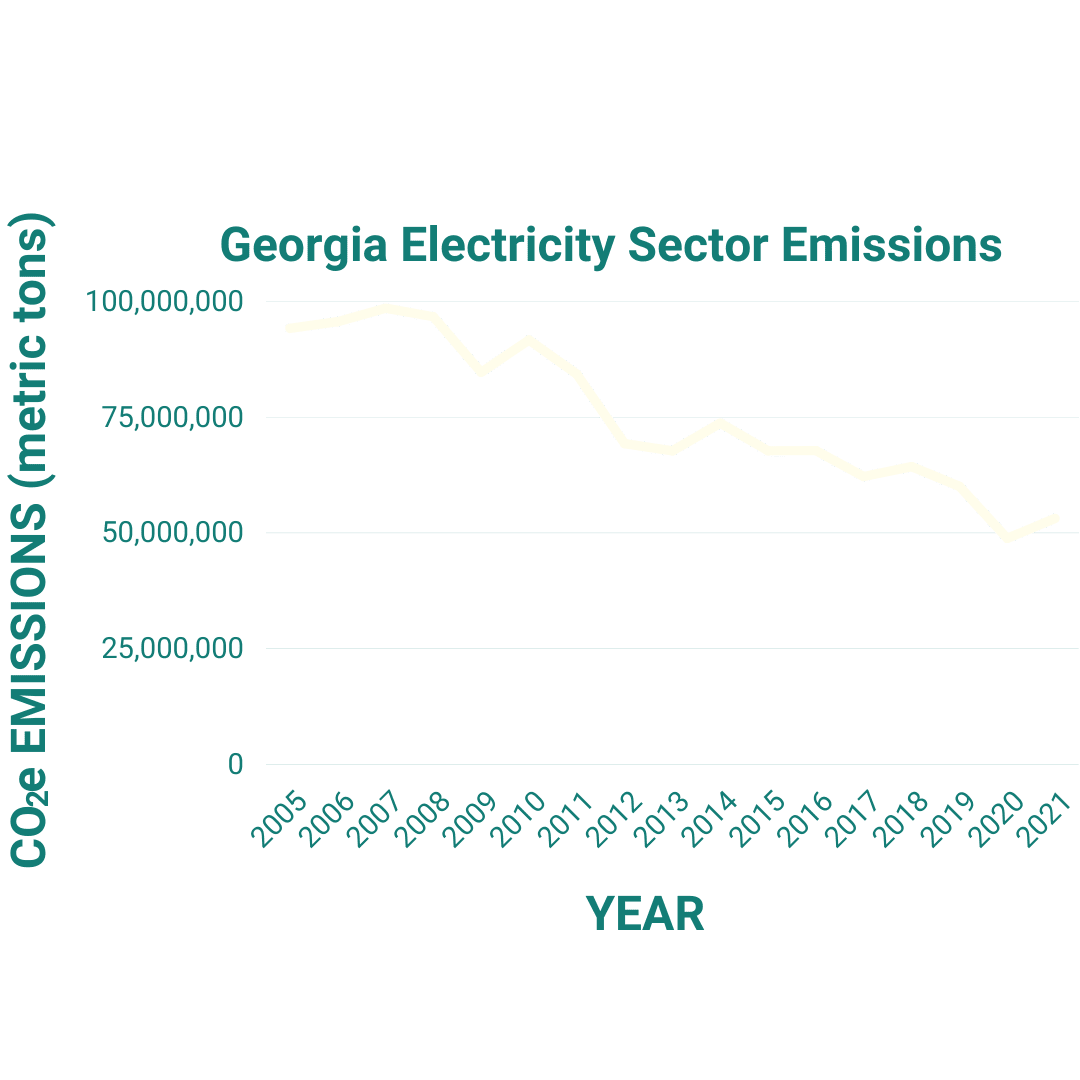
Electricity is Georgia’s second-largest source of greenhouse gas emissions. According to the Drawdown Georgia GHG Emissions Tracker, electricity sector emissions have decreased in recent years as coal plants were replaced with cleaner sources. In 2021, the electricity sector was responsible for about 53 million metric tons of GHG emissions.
Here’s where we are
Stories & Studies
Georgia Businesses Thrive When Decarbonization Is a Core Growth Strategy: Here’s How
For many companies, sustainability began as a reporting exercise. A compliance requirement. A line item in an annual report. But across Georgia, leading businesses are demonstrating something more powerful: when emissions reduction is embedded into enterprise
READ ON
How Capturing Landfill Methane Can Reduce Emissions and Strengthen Communities in Georgia
When most people think about climate solutions in Georgia, they think about solar panels, electric vehicles, or tree planting. But beneath the surface — quite literally — lies one of the most powerful and immediate opportunities to reduce greenhouse gas
READ ON
Education, Advocacy, and Equity: Local Climate Solutions at Work in Georgia
Across Georgia, community-based organizations are advancing climate solutions in meaningful, people-centered ways, from neighborhood composting hubs and home weatherization projects to clinician-led health advocacy and clean energy workforce training. These
READ ON


Frequently Asked Questions
Is my roof good for solar?
Drawdown Georgia has a climate solutions toolkit written by local experts to answer your questions about installing rooftop solar on your home in Georgia.
How many solar roofs does Georgia have?
Based on analysis of Google Rooftop, Georgia has 5,858 KW of installed rooftop solar and about 1,910 installations. Of these, 87% (1,654 installations) are located in 13 urban counties.
What is Solarize in Georgia?
Solarize is a community group that organizes crowdsource campaigns to bring down the costs of rooftop solar panels through bulk purchasing from selected distributors and installers. Rooftop installations conducted as part of a Solarize campaign total 4,008 7.77 kW as of July 2020, a big chunk of existing rooftop capacity in Georgia.
How much solar capacity is there in Georgia?
According to the Solar Energy Industries Association, as of early 2025, Georgia had nearly 7.5 gigawatts of solar PV capacity, which is enough to power over 875,000 homes.
How much utility-scale solar does Georgia have?
Georgia’s large-scale solar capacity reached 5.2 gigawatts as of early 2025 according to the U.S. Energy Information Administration. The Solar Energy Industries Association ranks Georgia fifth in the nation for utility-scale solar capacity.
Does solar create jobs in Georgia?
The Solar Energy Industries Association found that there were more than 5,600 solar jobs in Georgia as of early 2025, giving the state a solar jobs ranking of 14th in the nation.
Where can I learn more about demand response programs in Georgia?
Drawdown Georgia has a climate solutions toolkit written by local experts to answer your questions about demand response programs in our state.
How popular is landfill methane capture?
Nearly 72% of operating landfills in the U.S. capture landfill gas (methane) to generate electricity. Georgia has 66 GW of generating capacity at operating landfills.
Does my local landfill capture methane to reduce pollution?
The Environmental Protection Agency’s Landfill Methane Outreach Program maintains a database of over 2,600 municipal solid waste landfills in the United States. This database includes information about landfill gas energy projects in various stages, whether they are planned, under construction, operational, or shutdown.
Which industries use cogeneration in Georgia?
Georgia had 40 cogeneration facilities with a total capacity of 1.5 GW. Most of the largest facilities are industrial, such as pulp and paper, including a system run by Albany Green Energy at P&G’s paper factory that provides 100% of the steam energy to make Bounty paper towels and Charmin toilet paper.
How does my Georgia county compare to my neighbors on greenhouse gas emissions from the Electricity sector?
The County-Level Greenhouse Gas Emissions Tracker provides monthly greenhouse gas emission estimates for Georgia’s 159 counties. Emissions are categorized by sector to give us a picture of where emissions are now and how they change as we advance on our goal of drawing down Georgia’s carbon emissions.
To find your county’s emissions from electricity, visit the Greenhouse Gas Emissions Tracker and select your county on the map.